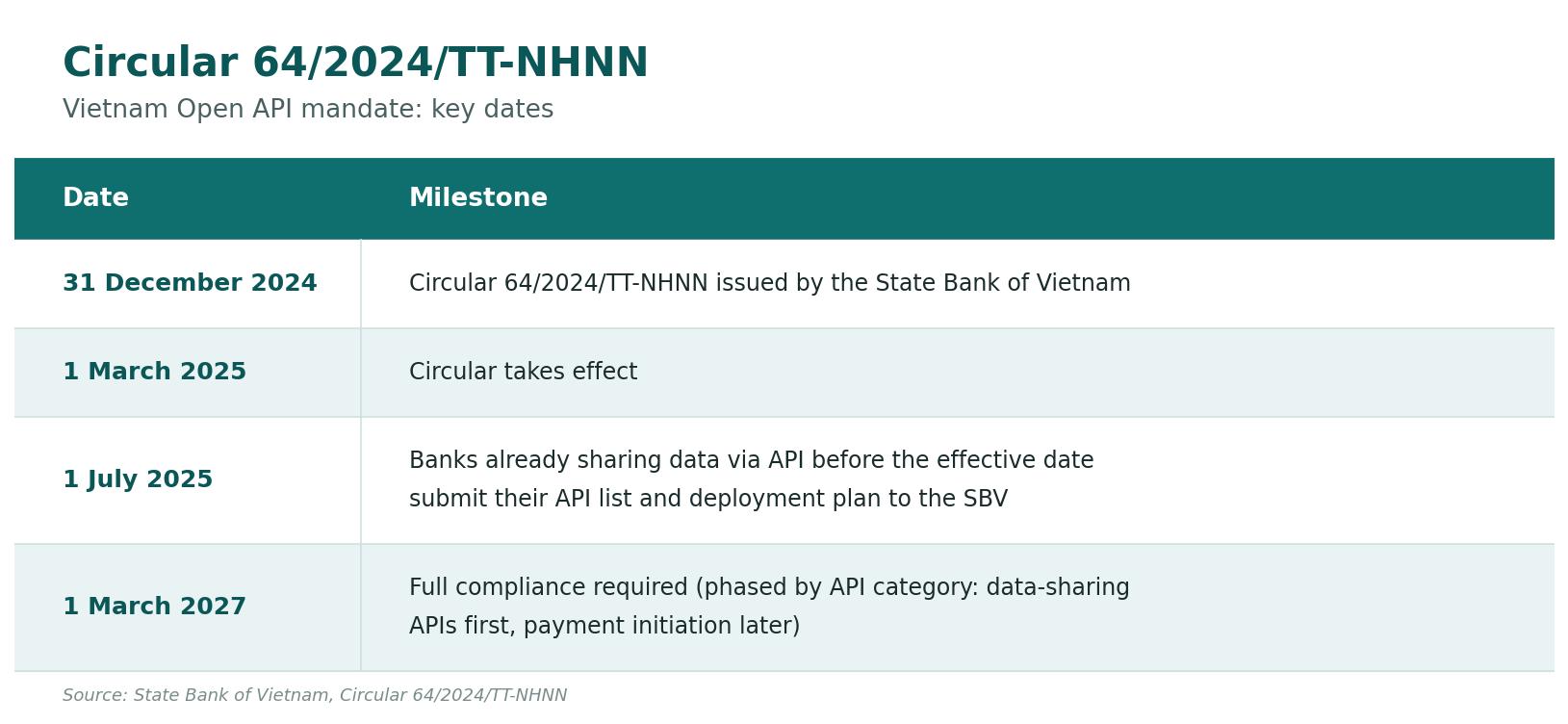
Circular 64/2024/TT-NHNN is the State Bank of Vietnam’s regulation making Open API mandatory for banks. It took effect on 1 March 2025 and requires full compliance by 1 March 2027, setting standards for consent-based data sharing with licensed third parties. This article explains what the mandate requires, and where the commercial upside sits for banks and fintechs.
What is Circular 64/2024/TT-NHNN?
Circular 64/2024/TT-NHNN is the State Bank of Vietnam’s rule for the Open API in the banking sector, and it is the instrument that turns Vietnam’s Open Banking ambition into a legal obligation. It provides implementing guidance for the 2024 Law on Credit Institutions and applies to commercial banks, cooperative banks, foreign bank branches, and other organizations that provide services through Open API. The principle is straightforward: with the customer’s consent, licensed third parties can securely access bank data and initiate services through standardized interfaces. “Open API,” “Open Banking,” and “Open Finance” are often used interchangeably for this shift; the circular’s own term is Open API.
What does Circular 64 require banks to do?
Three requirements stand out. First, standardization: banks must expose Open APIs built to the technical standards set out in the circular’s appendices, so third parties integrate against one specification rather than a different one for every bank. Second, a reporting step: banks already sharing data through APIs before the circular took effect were required to submit their API list and deployment plan to the SBV by 1 July 2025. Third, security: the circular sets controls for these interfaces, including customer authentication, encryption, and digital signatures. Access is consent-based throughout, covering data queries and payment initiation. The circular phases the rollout by API category, with data-sharing APIs first and payment-initiation APIs later, ahead of full compliance on 1 March 2027. Open API data sharing also sits within Vietnam’s controlled testing mechanism (regulatory sandbox) under Decree 94/2025/ND-CP.
Why is compliance the floor, not the finish line?
Because the infrastructure is the same. The API layer a bank stands up to satisfy Circular 64 is the exact layer that lets it sell embedded financial products, initiate payments outside the card networks, and package data into new services. A bank that scopes Circular 64 as a legal checkbox pays the full cost of the build and captures none of the upside. A bank that scopes it as a product platform pays the same cost and opens several new lines of revenue. The deadline is fixed either way. What differs is what the bank has to show for the spend.
Where is the revenue in Vietnam Open Finance?
Four opportunities carry the clearest commercial logic in Vietnam.
Embedded lending and alternative credit
Vietnam is still a cash-heavy market, and formal credit is thin: the country has roughly 19 debit cards in circulation for every credit card, so many consumers and small businesses lack the credit history lenders rely on. With consented transaction data, a lender can assess income and cash flow directly, approve thin-file applicants, and embed credit at the point of need. Revenue comes from higher approval rates, lower acquisition cost, and per-decision fees.
Account-to-account payments (Pay by Bank)
Vietnam already runs on real-time account transfers. The national switch, NAPAS, processed 8.9 billion instant transfers in 2024, with VietQR volumes more than doubling year on year. Payment initiation under Open API lets merchants and platforms move money straight from a bank account, bypassing card rails and their fees. For banks, that is transaction revenue and a defensible position at the checkout.
Data products and personal financial management
Aggregated, consented data supports budgeting, account aggregation, and financial-management tools that drive engagement and cross-sell. Direct fees are modest, but the value is stickiness and lead generation for higher-margin products.
Banking-as-a-service and API productization
Vietnam’s e-commerce platforms, super-apps, and fintechs are ready-made distribution channels. Banks that productize their APIs and price premium endpoints can earn through banking-as-a-service and revenue-share arrangements, rather than treating APIs as a cost center.
What makes Vietnam ready for this?
The demand side is already in place. Vietnam is one of the region’s fastest-growing cashless economies: NAPAS processed 9.56 billion transactions in 2024, up around 30% year on year, and QR payments have moved into everyday use ahead of cards. Market researchers estimate the fintech sector at roughly US$19 billion in 2025, with strong double-digit growth projected through the decade. The population is young, digital, and comfortable sharing data for a better experience. Circular 64 supplies the missing piece: a common, secure standard that turns that behavior into an addressable market.
How should a bank turn Circular 64 into revenue?
Treat the API layer as a product, not a compliance artifact. Build it once, to the standard, with a consent experience customers trust, then decide which endpoints are basic compliance and which are premium, monetizable services. Prioritize the use cases with near-term payback, lending and payments first, and partner where internal engineering capacity is the bottleneck. In our deployment experience across nine markets, the single most common cause of a missed go-live is waiting on a bank’s internal IT team to wire up integrations, so pairing the build with hands-on implementation support is what keeps the 2027 deadline realistic. For the choice of national model behind all of this, see our explainer on centralized vs. decentralized Open Finance.
Frequently asked questions
Does Circular 64 apply to fintechs and third-party providers, or only banks?
The direct obligations fall on banks: commercial banks, cooperative banks, and foreign bank branches must expose standardized Open APIs. Fintechs and other third parties participate as consumers of those APIs, accessing bank data and initiating payments with customer consent under the circular’s rules.
What can third parties access under Circular 64?
With the customer’s consent, licensed third parties can access account and transaction data and initiate payments through the bank’s Open APIs, within the technical and security standards the circular sets out in its appendices.
Is Open Banking mandatory in Vietnam?
Yes. Circular 64 makes implementing Open API mandatory for covered banks, with full compliance required by 1 March 2027. It is a binding regulation, not a voluntary framework.
How does Circular 64 relate to the 2024 Law on Credit Institutions?
Circular 64 provides implementing guidance for the 2024 Law on Credit Institutions, translating the law’s principles into concrete Open API standards, consent requirements, and security controls for the banking sector.
What happens if a bank misses the Circular 64 deadline?
Full compliance is required by 1 March 2027. As an SBV circular, it is binding on licensed institutions and enforced through the central bank’s ordinary supervision of credit institutions, so non-compliance is a supervisory and reputational risk, not an optional timeline.
Brankas, an Open Finance infrastructure provider with implementations across nine markets in APAC and MENA. Brankas builds the Open Finance Suite and helps banks turn open API mandates into revenue-ready products.
*Preparing for Circular 64, or planning what comes after it? Talk to our team.*



 Back
Back