What is SAMA’s Open Banking Framework?
The Open Banking Framework is the Saudi Central Bank’s rulebook and technical standard for consent-based financial data sharing and payments. It sits within the Kingdom’s Vision 2030 and the Financial Sector Development Program, which set out to grow the fintech sector and broaden access to financial services. SAMA has released the framework in stages: a first release focused on Account Information Services (AIS), and a second release focused on Payment Initiation Services (PIS). Under the hood, the standard defines three service families, Account Information (AIS), Letters of Guarantee (LG), and Payment Initiation (PIS), and it is built on the Financial-grade API (FAPI) security profile, with conformance certified through the OpenID Foundation. Each release standardizes a set of APIs and use cases rather than a single service. Both rely on standardized APIs, customer consent, and a shared set of security and operational requirements. SAMA’s own term for each stage is a release; this explainer also refers to them as Phase 1 and Phase 2 for readability. Although SAMA uses the term “Open Banking”, the framework provides the foundation for broader open finance in the Kingdom.
What are the phases of Saudi Arabia’s open banking rollout?
The rollout has followed a clear order: data sharing first, payments second, with a testing and certification environment running alongside, and formal licensing of providers now underway.
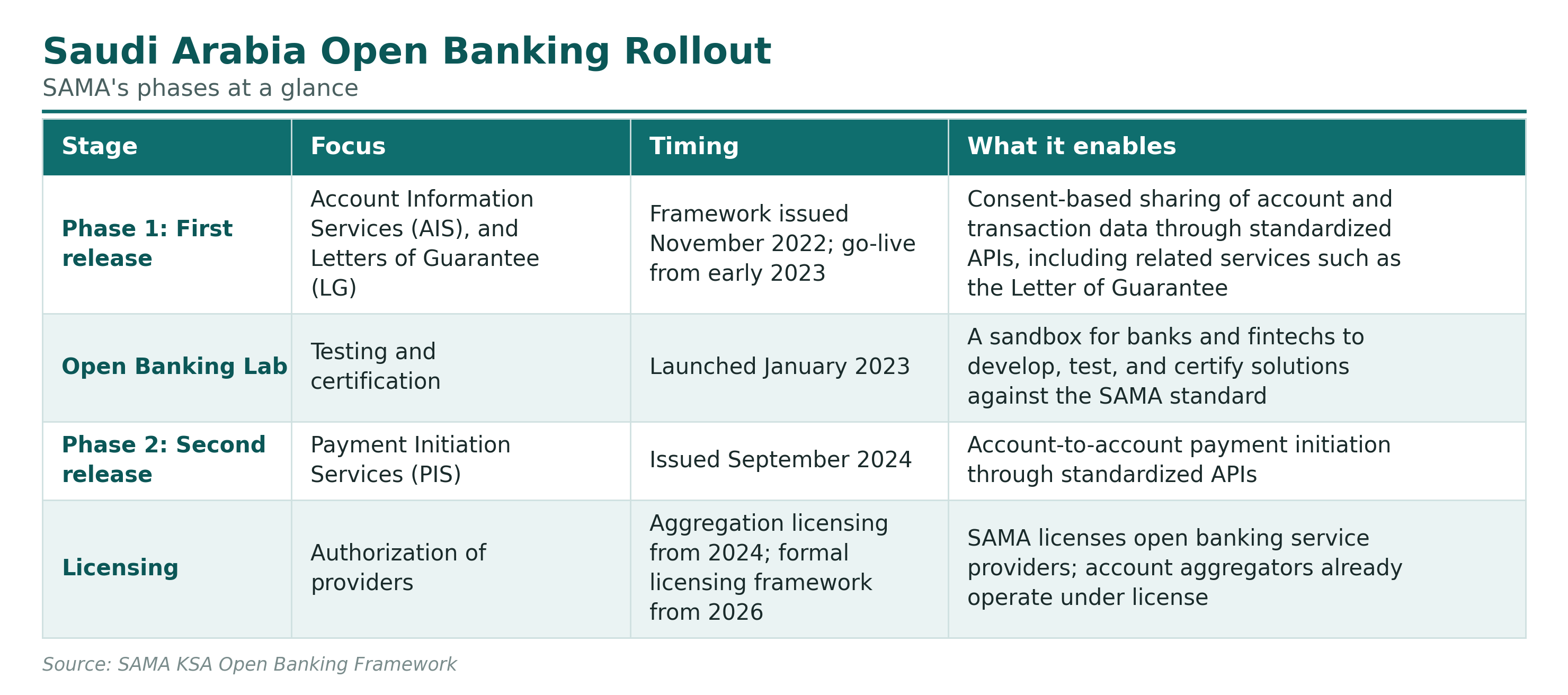
AIS established the data-sharing requirements. PIS added payment initiation on top of that foundation. The Open Banking Lab gives both sides a controlled place to prove their implementations before going live.
What services and use cases does the framework cover?
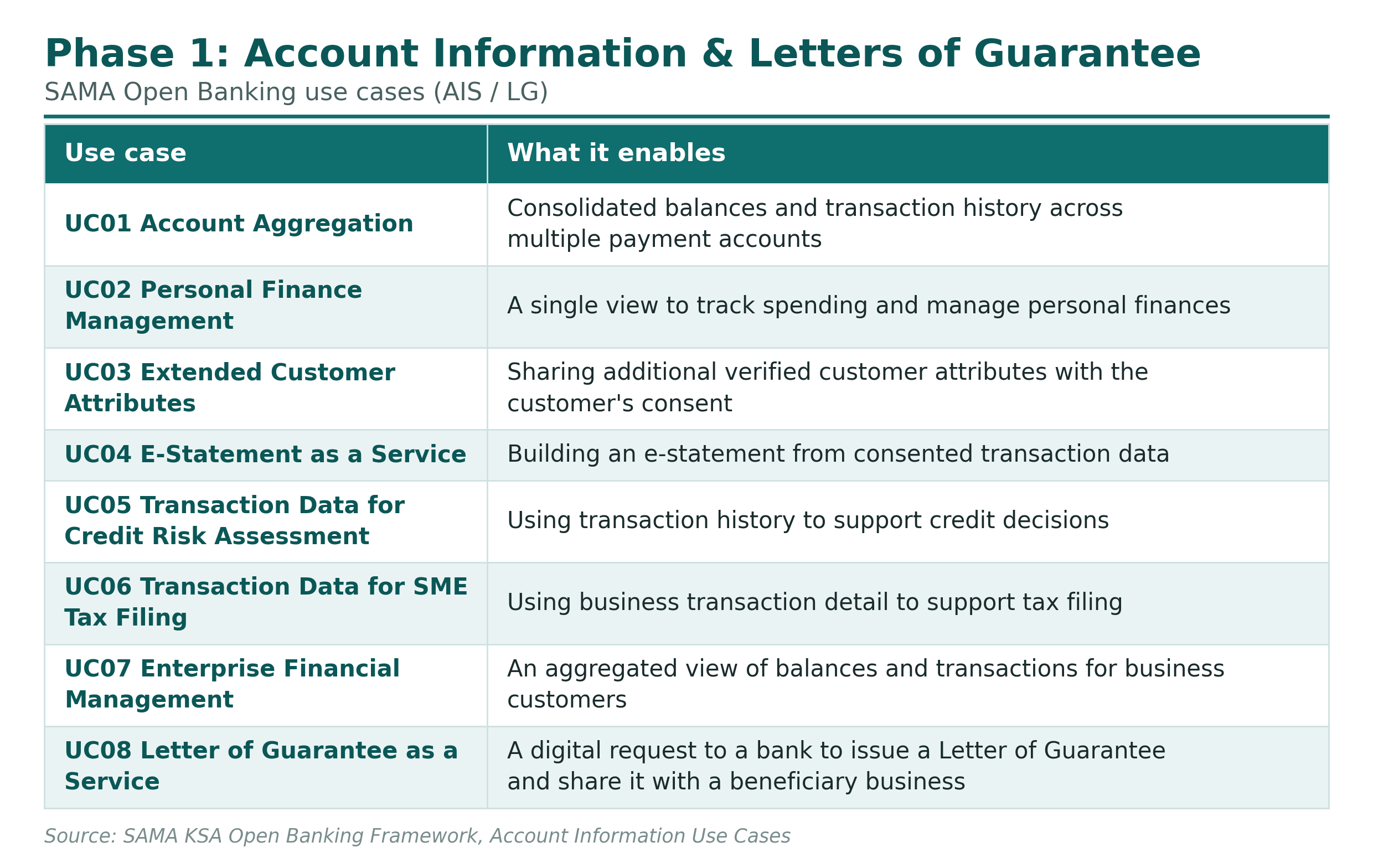
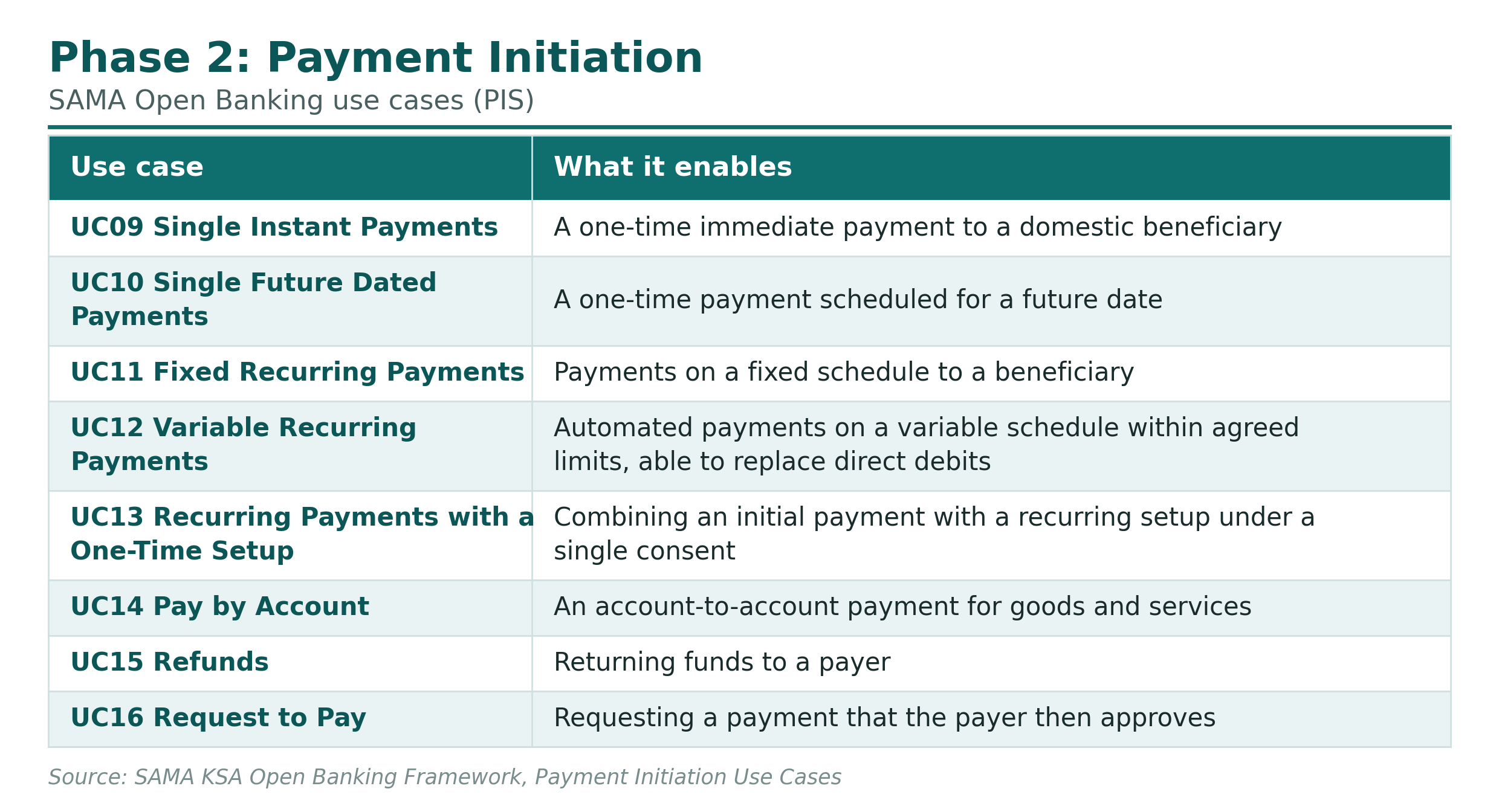
SAMA defined a specific catalogue of use cases per service, which is useful for a bank deciding what to build first. The account-information phase recommends eight use cases, and the payment-initiation phase provides eight more.
Who are the market participants?
The framework sorts participants into three groups: Payment Account Service Providers (PASPs), Third-Party Providers (TPPs), and other market participants. PASPs are the banks and account providers that expose the APIs; they are the data holders and must complete certification before enabling any TPP. TPPs are the licensed providers that consume the APIs as account information service providers (AISP), payment initiation service providers (PISP), or both, with additional sponsor and sponsored roles for firms operating under another provider’s license.
SAMA maintains public PASP and TPP registers of the institutions that are certified and live. The full current list is published in SAMA’s registers. For a bank, this means the counterparties requesting access are identifiable, certified entities, not anonymous sandbox projects.
How does certification and the Open Banking Lab work?
Implementations are tested against SAMA’s Business Rules and Standards (version 2024.09.01), and both sides must certify before connecting. PASPs certify by service, with separate certifications for retail AIS, corporate AIS, the corporate Letter of Guarantee, and payment initiation, while the PIS tests are split into batches by payment type and each batch produces its own report.
The Open Banking Lab provides two tools that a CIO should plan around. The Functional Conformance Suite is a Docker-based test suite that checks an implementation against the AIS, LG, and PIS standards. The Model Bank is a life-like simulation of a PASP, with synthetic accounts and transaction data, so developers can build and test against the APIs without connecting to a real bank or touching live customer data. On top of functional conformance, the framework requires FAPI security certification through the OpenID Foundation, using mutual TLS and private-key client authentication, so the security profile is a defined, testable target rather than a general expectation.
The first release centers on sharing account and transaction data with licensed third parties, with the customer’s consent. SAMA issued the first version of the framework in November 2022, with banks and fintechs expected to be ready in the following months. This phase covers more than balances and transactions. Alongside account aggregation and personal financial management, it includes the Letter of Guarantee service (UC08), certified separately as a corporate service. For a bank, AIS means exposing account information through APIs that conform to the SAMA standard, capturing and honoring customer consent, and meeting the framework’s authentication and security requirements.
Phase 2: Payment Initiation Services (Second Release)
The second release extends the framework to payments. SAMA issued the payment initiation release in September 2024, enabling account-to-account payments initiated by licensed providers at the customer’s request. Its use cases range from single instant and future-dated payments to fixed and variable recurring payments, pay by account, refunds, and request to pay. For a bank, PIS adds payment initiation endpoints, stronger transaction authentication, and the operational controls needed to process initiated payments reliably. SAMA is expected to expand the framework’s services and use cases in subsequent releases.
What is the Open Banking Lab, and why does it matter?
The Open Banking Lab is a technical testing environment that SAMA launched in January 2023. It lets banks and fintechs develop, test, and certify their implementations against the framework’s standards before going to production. Banks should include Open Banking Lab testing in their implementation plans before scheduling production deployment.
What stage is Saudi Arabia at now?
Saudi Arabia is past the sandbox-only stage. SAMA has moved to formal licensing of open banking service providers, and licensed providers, including account aggregators, already operate in the market. SAMA licensed providers that completed the regulatory sandbox, and it has set out a licensing framework for firms providing open banking services. The public TPP register bears this out, listing providers with a status of licensed or permitted.
What does each phase require from a bank’s technology teams?
Banks need to address four areas across AIS and PIS: APIs, consent management, security, and conformance testing.
Standardized APIs: banks expose account data and, later, payment initiation through interfaces built to the SAMA specification.
Consent management: a clear record of what the customer has permitted, for how long, and the ability to withdraw it.
Authentication and security: FAPI-grade security certified through the OpenID Foundation, using mutual TLS and private-key client authentication, strong authentication and the framework’s security controls on every call.
Conformance: certification through the Open Banking Lab before production. Building shared API, consent, and security components for AIS and PIS can reduce duplicated engineering work.
How should a bank CIO in Saudi Arabia prepare for Open Banking Phase Two?
Build the API, consent, and security layer once, to the SAMA standard, so that each release extends the same foundation rather than starting over. Plan conformance testing in the Open Banking Lab into the schedule from the start, including the Functional Conformance Suite and the FAPI certification, and remember that payment initiation certifies in batches by payment type. Banks with limited engineering capacity can consider an infrastructure provider to support API implementation and conformance testing.
Frequently asked questions
Who regulates open banking in Saudi Arabia?
The Saudi Central Bank (SAMA) issues the Open Banking Framework and oversees the program, which sits within Vision 2030 and the Financial Sector Development Program.
What are the phases of SAMA’s open banking rollout?
SAMA released the framework in stages: a first release for Account Information Services (account and transaction data) in November 2022, and a second release for Payment Initiation Services (account-to-account payments) in 2024, supported by the Open Banking Lab launched in January 2023. SAMA now formally licenses open banking service providers.
What services and use cases does SAMA’s open banking cover?
The standard defines three service families: Account Information (AIS), Letters of Guarantee (LG), and Payment Initiation (PIS). The first phase shortlists eight AIS use cases (including account aggregation, personal financial management, and Letter of Guarantee as a service), and the second phase shortlists eight PIS use cases (including single, future-dated, and recurring payments, pay by account, refunds, and request to pay).
Where does the Letter of Guarantee fit?
Letter of Guarantee is a distinct service in the KSA standard, shortlisted in the first (account-information) phase as use case UC08 and certified separately as a corporate service. It is part of the first release, not the payment-initiation second release.
What is the difference between AIS and PIS?
Account Information Services (AIS) cover consent-based sharing of account and transaction data. Payment Initiation Services (PIS) allow a licensed provider to initiate a payment from the customer’s account at the customer’s request. PIS builds on the same standardized, consent-based foundation as AIS.
Does SAMA’s open banking cover more than account data and payments?
Yes. Each release standardizes a set of services. Beyond core account information and payment initiation, the first release’s Account Information scope is reported to include a Letter of Guarantee API, extending open banking into corporate banking services.
Are there licensed open banking providers in Saudi Arabia?
Yes. SAMA has licensed open banking service providers, including account aggregators, and licensed providers already operate in the market following the regulatory sandbox. SAMA maintains public PASP and TPP registers listing the banks and providers that are certified and live.
What is the SAMA Open Banking Lab?
It is a technical testing environment where banks and fintechs develop, test, and certify their implementations against the SAMA standard before launching in production, using the Functional Conformance Suite and a Model Bank that simulates a bank with synthetic data.
Is Saudi Arabia moving toward open finance?
SAMA’s current program is the Open Banking Framework, covering account information and payment initiation. It is widely regarded as the foundation for broader open finance, with scope expected to expand over time.
Brankas builds the Open Finance Suite and helps banks turn open banking frameworks into working infrastructure. Preparing for open banking in Saudi Arabia? Talk to our team, and watch for our Saudi Arabia white paper in March.


 Back